

What Does Homeowners Insurance Cover for Tornado Damage? (And What It Might Not Pay)
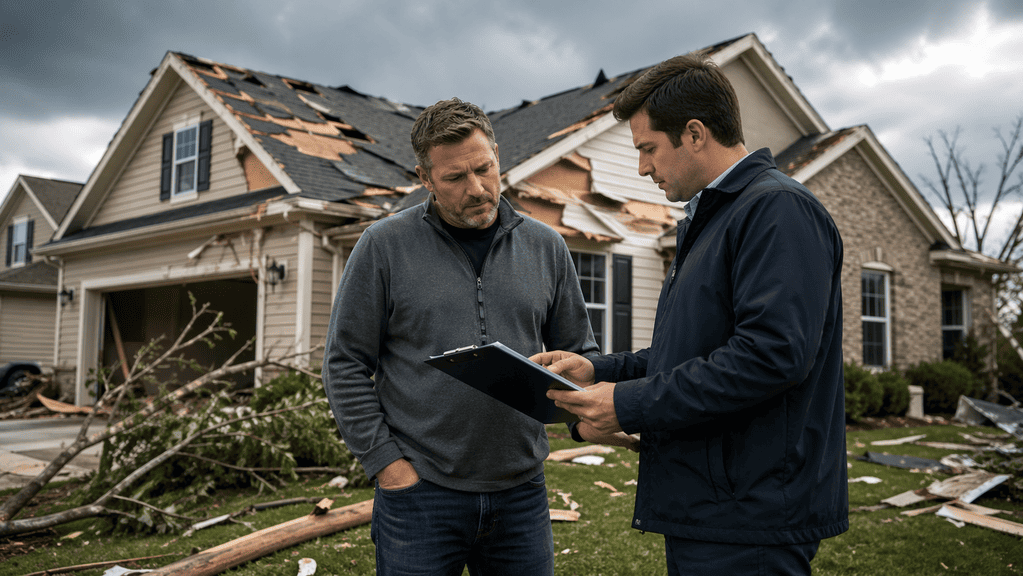
A tornado doesn’t give you time to prepare. One moment your house is standing; the next, the roof is gone, windows are blown out, and you’re on hold with your insurance company trying to understand what happens next. If you’re reading this from a damaged property right now, here is the direct answer: yes, standard homeowners insurance generally covers tornado damage under the windstorm peril. Your policy should pay for structural repairs, damaged belongings, and temporary housing while your home is being restored.
But “covered” and “paid in full” are two different things. Insurance companies have financial incentives to minimize what they pay, and the gap between what your policy promises and what arrives in a settlement check can be significant. This article explains exactly what a standard homeowners policy covers after a tornado, where coverage ends, what Florida-specific laws add to the picture, and what to do when an insurer pushes back. Whether you’re standing in front of a damaged house today or reviewing your policy before storm season, you’ll find both the immediate answers and the deeper detail here.
Understanding what a policy covers is only the beginning. Homeowners should also review what tornado damage may not be covered by homeowners insurance, including losses affected by exclusions or separate coverage requirements. Water losses deserve particular attention because tornado-related flooding may be treated differently from wind-driven rain. If the home becomes temporarily uninhabitable, Additional Living Expenses after tornado damage may also help cover certain costs while repairs are underway.
Does standard homeowners insurance cover tornado damage?
Yes. A tornado is classified as a windstorm peril under a standard HO-3 policy, so damage from high winds, wind-borne debris, and the structural forces a tornado generates is a covered loss. You don’t need a separate tornado insurance product — coverage is built into the standard windstorm peril alongside hail and straight-line winds. For a deeper look at how this coverage works in Florida specifically, see whether tornado damage is covered by your home insurance policy.
What you do need to verify is whether your specific policy restricts or excludes windstorm coverage. Some policies in high-risk coastal zones do. Locate your declarations page and confirm no windstorm exclusion endorsement is present before assuming you’re covered.
What four types of coverage pay out after a tornado?
Does dwelling coverage (Coverage A) pay for a destroyed roof or collapsed walls?
Coverage A covers the physical structure: roof, walls, windows, siding, and — in a severe event — complete structural collapse requiring a full rebuild. One critical sub-component is Ordinance or Law coverage, which pays for the additional cost of bringing repairs up to current Florida Building Code. Without it, the gap between what your insurer pays and what a code-compliant repair actually costs falls entirely on you. Florida’s code updates every three years, making this gap real on any older home.
Are detached garages, sheds, and fences covered (Coverage B)?
Coverage B protects detached structures — garages, carports, fences, outbuildings, and screened pool enclosures — typically at 10% of the dwelling limit. The key limitation is depreciation: insurers frequently pay only the actual cash value (ACV) for Coverage B structures. A fence that costs $4,000 to replace may generate a check for $1,200 after the insurer’s depreciation schedule is applied. For a full explanation of how ACV vs. RCV affects your payout, see the real cost difference between actual cash value and replacement cost in tornado claims.
Are personal belongings covered if the roof blows off (Coverage C)?
Coverage C reimburses damaged personal property — furniture, appliances, clothing, electronics — subject to your policy’s payout method. An ACV policy applies depreciation to every item. A Replacement Cost Value (RCV) policy pays what it costs to replace the item new. Policies also impose sub-limits on high-value items like jewelry and art, which require separate scheduled endorsements for full coverage.
Does insurance pay for a hotel while my home is being repaired (Coverage D)?
Coverage D — Additional Living Expenses (ALE) — covers the increased cost of temporary housing, meals above your normal food budget, moving and storage costs, and other expenses above your normal standard of living. Most Florida policies cap ALE at 20% of Coverage A. On a $400,000 home, that’s $80,000. Track all displacement expenses from day one.
What tornado damage is NOT covered by standard homeowners insurance?
Flood damage is excluded regardless of what caused it — rain entering through a tornado-created opening is covered, but water rising from the ground is not. Vehicles are not covered under homeowners policies; tornado damage to a car falls under the comprehensive portion of an auto insurance policy. Pre-existing damage and wear and tear may be used to reduce claims, particularly on older roofs. For the full list of exclusions and how insurers apply them, see what tornado damage your homeowners policy will not pay for.
Will the hurricane deductible apply to my tornado claim in Florida?
Under Florida Statute §627.4025, if the NHC issues any watch or warning for any part of Florida, the hurricane deductible applies to claims statewide for the duration of that warning plus 72 hours. This deductible is calculated as a percentage of Coverage A — commonly 2%–10% — not the standard flat-dollar AOP deductible. On a $400,000 home with a 5% hurricane deductible, the homeowner absorbs the first $20,000 before the insurer pays anything.
What are my deadlines under Florida law and how do I document my claim?
Florida Statute §627.70132 requires an initial claim notice within one year of the date of loss and supplemental claims within 18 months. Missing the one-year initial deadline permanently forfeits your right to compensation. Follow the correct steps when filing your claim from the moment damage occurs, and photograph all damage before any cleanup or temporary repairs begin to protect every coverage type.
Not Sure What Your Tornado Policy Actually Covers? Kennon Law Can Help.
Many Florida homeowners don’t discover the limits of their coverage until a settlement check falls short. Kennon Law’s tornado insurance claim attorneys review policies, challenge underpayments across all four coverage types, and fight for the full recovery you’re entitled to. Contact Kennon Law today for a free consultation.