


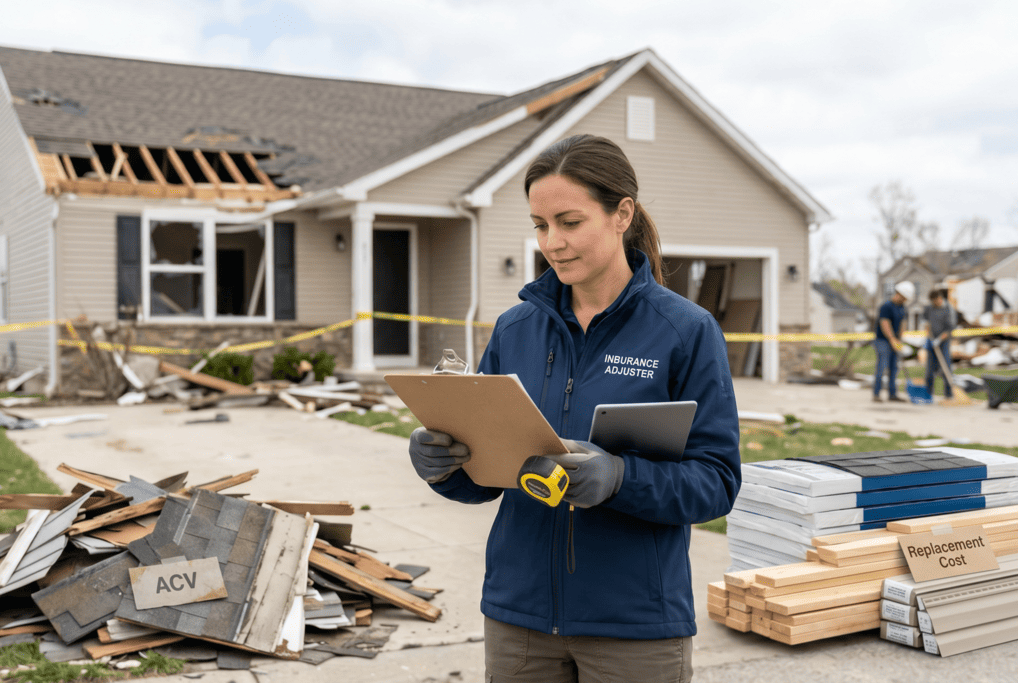
A tornado hits. The adjuster inspects. Weeks later, a check arrives — and it is thousands of dollars short of what your contractor quoted to fix the damage. That gap is not always a mistake. It is often the direct result of how your policy values damaged property, specifically whether it pays actual cash value (ACV) or replacement cost value (RCV).
Most homeowners discover this distinction at the worst possible moment: after the storm, when they are already managing displacement, contractor scheduling, and mounting stress. This article explains what ACV and RCV mean in practice, how they apply differently to your roof, your structure, and your belongings, why the two-step payout process causes homeowners to permanently forfeit money they were owed, and what the Florida legislative landscape — reshaped significantly by Senate Bill 2-A (SB 2-A) in 2022 — means for anyone disputing a tornado claim today.
Valuation can have a major impact on the amount ultimately paid after a storm. Understanding ACV and replacement cost is therefore important when pursuing a tornado insurance claim or other homeowners insurance claim. When the insurer accepts coverage but its valuation leaves the policyholder without adequate funds for covered repairs, the disagreement may develop into an underpaid insurance claim.
what homeowners insurance covers for tornado damage →
If you have already received a settlement check that does not add up, the explanation — and your options — start here.
What is the difference between ACV and replacement cost value in a tornado claim?
Your policy values damaged property in one of two ways: actual cash value (ACV) or replacement cost value (RCV). ACV pays what your property was worth at the moment it was destroyed — meaning the insurer deducts depreciation based on age and condition before issuing a check. RCV pays the actual cost to repair or replace damaged property with materials of similar kind and quality at current prices, with no depreciation deduction.
The gap between these two numbers is often the reason a tornado claim payout falls thousands of dollars short of the contractor’s estimate. A roof that costs $20,000 to replace today might receive an ACV payment of $10,000 after a 50% depreciation deduction — leaving the homeowner responsible for the difference. Before reviewing your settlement, it helps to understand what your homeowners policy covers in the first place (“What Does Homeowners Insurance Cover for Tornado Damage? (And What It Might Not Pay)”).
How large can the ACV-RCV gap realistically be?
On major components like roofing, the gap regularly runs into five figures. A 15-year-old roof depreciated at 50% on a $20,000 replacement produces an $8,000–$10,000 shortfall before accounting for siding, windows, fencing, or interior damage. On a whole-home loss, the difference between ACV and RCV can easily reach $50,000–$100,000.
How does depreciation work — and who controls the calculation?
The baseline formula is ACV = Replacement Cost − Depreciation. Depreciation is calculated by dividing the replacement cost by the component’s expected useful life, then multiplying by its age. An adjuster applying this to a 12-year-old roof with a 20-year useful life would apply 60% depreciation.
What the formula obscures is the subjectivity embedded in two inputs: the assigned useful life and the pre-storm condition assessment. Insurers control both figures. In Florida, adjusters often cite the state’s UV radiation, humidity, and thermal cycling to justify aggressive depreciation schedules — even on well-maintained roofs. These rates can be challenged with documentation.
Can insurers depreciate labor costs?
Whether insurers can depreciate labor is one of the most actively contested issues in property insurance claims. Insurers argue that total project cost reflects the age of what’s being replaced; policyholders argue that labor has no depreciable useful life. Courts are split. Homeowners should request the full Xactimate or Symbility estimate and verify that labor costs are not being separately deducted from the ACV calculation.
Does the ACV or RCV rule apply uniformly across my entire policy?
Not necessarily. Coverage A (dwelling structure) typically uses RCV under a standard HO-3 policy — but endorsements and roof-specific riders can override this for specific components. Coverage C (personal property) often defaults to ACV even when the dwelling is on RCV terms. Verify the valuation method listed under each coverage type on your declarations page. For a broader view of what each coverage type includes, see what tornado damage is and isn’t covered under standard policies.
What is the ACV roof endorsement — and how does it quietly change my coverage?
The ACV roof endorsement converts roof coverage from RCV to ACV, regardless of how the rest of the dwelling is covered. It’s common in Florida, where carriers restrict RCV on roofs older than 15–20 years. For homeowners who have already received a low payout on a roof claim, understanding the common reasons a roof damage claim gets denied or reduced is a critical next step.
What is recoverable depreciation — and how do I claim it?
On an RCV policy, the insurer initially pays the ACV (depreciated) amount. After repairs are completed, you submit documentation — signed contractor invoices, completion certificates — and the insurer releases the withheld amount, called recoverable depreciation. Florida policies commonly impose a 180-day deadline from the date of loss to submit proof. This deadline is not communicated proactively. On a $30,000 roof replacement where $12,000 was withheld, missing the deadline means that money is permanently forfeited.
How do I challenge an excessive depreciation calculation?
Request the full depreciation breakdown in writing and compare it against an independent contractor’s or public adjuster’s estimate. Pre-storm documentation — maintenance records, inspection reports, dated photographs — directly supports a challenge. Knowing how to photograph and document your property’s pre-storm condition is the foundation of this defense. If the gap between the insurer’s estimate and yours is significant, review the step-by-step process for filing and escalating a tornado claim.