


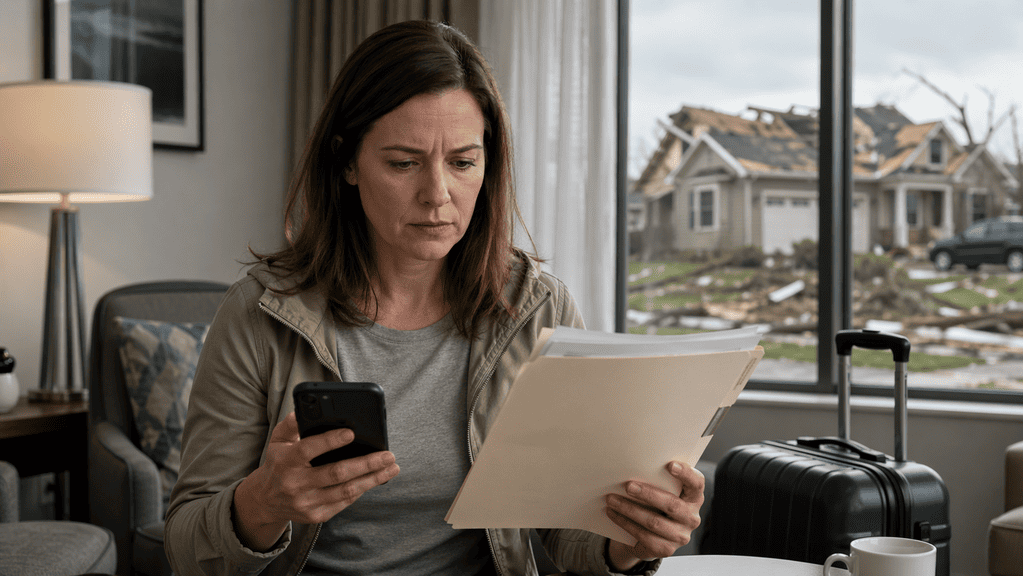
A tornado damaged your home. You’re in a hotel, at a family member’s house, or in a short-term rental with no clear sense of how long this will last. Your mortgage is still due. Your normal bills haven’t stopped. And now you’re trying to figure out what your insurance will actually pay for while you’re away from home.
The answer is: more than most homeowners expect — but also less than some assume, and not automatically. Additional Living Expenses (ALE) coverage, also called Loss of Use or Coverage D, is a standard part of most homeowners insurance policies. It exists specifically for this situation: to cover the increased cost of living somewhere else while your home is being repaired after a covered event.
Understanding what ALE covers, what it excludes, how the limits work, and — critically — how insurers use specific policy language to cut payments off early is the difference between getting through displacement with financial support and absorbing tens of thousands of dollars in out-of-pocket living costs. This guide covers all of it, including Florida-specific laws that can significantly extend both your ALE entitlement and the disputes that surround it.
Additional Living Expenses are only one component of the coverage that may become relevant after severe property damage. A complete tornado insurance claim may also involve dwelling repairs, personal property, debris removal, and other covered losses under a homeowners insurance claim. If the carrier recognizes the loss but fails to adequately account for ALE or other covered expenses, the homeowner may be dealing with an underpaid insurance claim.
What is ALE coverage and when does it trigger after a tornado?
Additional Living Expenses (ALE) — also called Loss of Use or Coverage D — is a standard component of most homeowners insurance policies. It covers the increased cost of living somewhere else while your home is being repaired after a covered loss. It doesn’t cover your total living costs: it covers the difference between what you’re spending now and what you would normally spend.
ALE triggers when two conditions are both met: the event must be a covered peril, and the home must be uninhabitable as a result. Tornado damage is a covered peril under a standard HO-3 policy, so a tornado that renders your home uninhabitable satisfies both conditions. “Uninhabitable” is broader than structural collapse — a home with no running water, no functioning sanitation, or unsafe occupancy conditions due to debris or active mold from water intrusion can support an ALE claim even if the structure is standing. To understand which tornado-related losses trigger a claim in the first place, see whether tornado damage is covered by your home insurance policy.
What does ALE actually cover after tornado displacement?
ALE covers the net increase in living expenses caused by displacement. This includes temporary housing (hotels, short-term rentals, or month-to-month leases reasonably comparable to your normal home), increased food costs above your normal grocery budget when no kitchen is available, pet boarding when temporary housing doesn’t allow animals, storage unit fees for belongings removed from the damaged home, additional transportation costs when your temporary housing is farther from work or school, utility connection fees at the temporary residence, and laundry services when you can’t access your own washer and dryer.
ALE does not cover your mortgage, property taxes, or utility bills on the damaged home. Those obligations continue unchanged regardless of displacement. For a full picture of each coverage type in your policy, see what your homeowners insurance covers for tornado damage
What are the dollar and time limits on ALE coverage?
Under a standard HO-3, ALE is typically set at 20–30% of your Coverage A limit. On a $400,000 home, that’s $80,000–$120,000. Most policies cap the covered period at 12 months, though some extend to 24.
Post-disaster contractor backlogs, material shortages, and permit delays routinely push repair timelines past 12 months. If your ALE limit is approaching exhaustion before your home is livable, consult a public adjuster or attorney immediately. Understanding how long a tornado insurance claim typically takes from filing to settlement helps set realistic expectations around these timelines.
How does the “shortest time required” clause let insurers cut off ALE early?
Standard ALE policies cover displacement for the “shortest time required to repair or replace the damage.” Insurers use this clause to terminate payments based on their internal repair estimate — regardless of how long repairs are actually taking. When delays occur, get written documentation from your contractor explaining the cause and revised timeline. A letter confirming a permit-related or code-compliance delay is documented proof that the required repair period is longer than the insurer claims, and it shifts the burden back onto the carrier.
What statutory protections apply to Florida ALE claims?
Under Florida Statute §627.70131, insurers must acknowledge a claim within 7 days, make a coverage determination within 30 days, and pay or deny within 60 days. Missing these deadlines may constitute a statutory violation and creates leverage in a dispute. The Florida Matching Rule (§626.9744) requires replacement materials to match undamaged areas in quality, color, and size — which can legally extend the repair scope and therefore the ALE period well beyond the insurer’s initial estimate.
How do I document ALE expenses so nothing gets denied?
Pull three months of pre-tornado bank statements to establish your normal spending baseline. Keep every receipt from the day you leave your home. Submit in batches every one to two weeks rather than accumulating months of documentation. Following the correct steps when filing your tornado insurance claim from day one ensures your ALE is properly invoked and tracked. Request an upfront ALE cash advance in writing at the start of the claim to avoid financing displacement entirely out of pocket.
Displaced After a Tornado and Unsure What Your Insurer Owes You? Kennon Law Can Help.
ALE disputes — whether over habitability determinations, timeline cutoffs, or denied expense line items — are among the most common ways Florida homeowners lose money they’re entitled to. Kennon Law’s tornado insurance claim attorneys fight for full ALE recovery on behalf of displaced policyholders. Contact Kennon Law today for a free consultation.